Honors Research
A traditional method of achieving 'Honors' or 'High Honors' in economics is by initiating a research project in ECON 85 and then writing an Honors thesis (ECON 87) in the senior year. A complete description of the Honors Program is given here. On this page are examples of honors theses written by current and alumni econ majors.
Honors Recipients 2025 - 2026
Graduating with Honors in Economics
- Tuna Akmehmet
- Cooper C. Camp
- Felix C. Feldman
- Gabriel B. Gottesman
- Hawa O. Hamidou Tabayi
- Luke D. McMahon
- Brian E. Moore
- Orlando A. Valladares Fernandez
- Emma L. Vaughan
- Harshith Yallampalli
- Stephanie R. Zoltick
Graduating with High Honors in Economics
- Julia A. Abbott, “Do Violent Shocks Shift Migration Patterns? Educational Selection in Middle Eastern Immigration to the United States.” (Advisor Melinda Petre)
- Sabriel L. Achong, “It Takes More Than A Village: The Impact of Expanded Free Childcare in England.” (Advisor Elizabeth Cascio)
- Arjun Anand, “Demography, Human Capital, and Structural Change.” (Advisor Treb Allen)
- Fabiana Araujo Rincon, “Selective Contagion: Sovereign Credit Integration and Heterogeneous Shock Transmission in Emerging Equity and Derivative Markets.” (Advisor Bruce Sacerdote)
- Shakeb Arsalan, “New Neighbors: The Effect of Refugee Housing Openings on Rental Prices in Berlin.” (Advisor Ethan Lewis)
- Lauren A. Calabrese, “Delayed Marriage, Limited Empowerment: Evidence from Nepal’s 2002
Child Marriage Reform.” (Advisors Meredith Startz and Claudia Olivetti) - Philip C. Ernst, “Are Greenfield Cross-Border Investments Sensitive to US Trade Policy? An Investigation of Responses to Liberation Day Tariff Announcements.” (Advisor Bruce Sacerdote)
- Felix C. Feldman, “Trade Elasticities in the 21st Century: The Red Sea Crisis as a Natural Experiment in Altering Trade Distances.” (Advisor Matthew Grant)
- Kiara C. Freidberg, “Online, But On The Rise? Impact of Remote Work on Mothers' Career Advancement.” (Advisor Ethan Lewis)
- Favion D. Harvard, “International Students as Housing Market Stabilizers.”
(Advisor Bruce Sacerdote) - Hannah W. Huang, “Special Economic Zones and Industrial Pollution: Evidence from Vietnam.”
(Advisor Meredith Startz) - Cooper C. Hyldahl, “Rent Capitalization and Military Housing Compensation: Evidence from the FY2015 Basic Allowance for Housing Rollback.” (Advisor Elizabeth Cascio)
- Josephine J. Lee, “Trade Liberalization and Local Labor Markets: Evidence from the U.S.-Korea Free Trade Agreement.” (Advisor Douglas Irwin)
- Vy H. Nguyen, “From Classroom to Labor Markets:Impact of the 2016 STEM OPT Extension on International Students’ Major Choices and Local Employment.” (Advisor Treb Allen)
- Dylan G. Parikh, “Transmission of Firm-Level Demand Shocks to Stock Returns: Evidence from 10-K Text Analysis.” (Advisor Bruce Sacerdote)
- Hayley S. Sciubba, “Individualism and Momentum Revisited: Evidence on the Persistence of Cultural Drivers in Stock Market Returns.” (Advisor Eric Zitzewitz)
- Matthew J. Sebastian, “Implied Variance Asymmetry as a Predictor of Stock Returns Around Quarterly Earnings Dates.” (Advisor Bruce Sacerdote)
- Boau-Lilly Shepherd, “Policy Whiplash: Tariffs and Uncertainty Among Firms and Investors in 2025.” (Advisor Bruce Sacerdote)
- Ethan K. Sun, “There Goes the Neighborhood: How Gun Violence Affects Housing Prices.” (Advisor Steven Mello)
- Jack S. Vawrinek, “How Do Former Consultants Manage Firms Differently?” (Advisor Eric Zitzewitz)
- Luke R. Wisniewski, “Do States Know Best? The Impact of Every Student Succeeds on Achievement.” (Advisor Ethan Lewis)
- Joshua S. Wolfson, “Determinants of Public-to-Private Transitions: Evidence from Firm-Level Selection Patterns.” (Advisor Bruce Sacerdote)
- Harshith Yallampalli, “Insurance Disruptions and Infant Health: Evidence from the 2023 Medicaid Unwinding.” (Advisor Elizabeth Cascio)
Lewis H. Haney Prize (Outstanding Honors Thesis)
- Lauren A. Calabrese
- Felix C. Feldman
- Cooper C. Hyldahl
- Josephine J. Lee
Nelson A. Rockefeller Prize (Best Performance in the Major)
- Arjun Anand
Economics Department Service and Leadership Award
- Hannah W. Huang
- Ethan K. Sun
- Luke R. Wisniewski
Graduating with Honors in Economics
- Jivan Achar, “Understanding the Muslim Infant Mortality Advantage over Time: NeighborhoodComposition and Sanitation Patterns in India.” (Advisor Paul Novosad)
- Julian C. Davis
- Carolina E. Escribano Caceres
- Arne W. Grette
- Tigerlily H. Jensen
- Amara J. Jones-Myers, “Women Teaching Women: Exploring In-Group Bias Between Teachers and Students.” (Advisor Bruce Sacerdote)
- Alexander A. Knox-Jones
- Catherine S. Nemeskal
- Ryan P. Pettit
- Vicky Pham
- Julia C. Schwed, “The Effect of Abortion Bans on Employment and Fertility.” (Advisor Claudia Olivetti)
- Katherine E. Stidolph
- Albert Zhang
Graduating with High Honors in Economics
- Pahal A. Ahuja, “Trauma and Test Scores: Measuring Educational Outcomes Following School Shootings.” (Advisors Elizabeth Cascio and Bruce Sacerdote)
- Ochir Batzorig, “Resource Booms and Local Development: Evidence from Mongolia.”
(Advisor Treb Allen) - Nicholas M. Burke, “Market Efficiency in the Wake of Layoffs.” (Advisor Bruce Sacerdote)
- Kevin J. Cao, “Why Do People Support the Alt-Right? Evidence From Germany during Refugee Crises.” (Advisors Ethan Lewis and Bruce Sacerdote)
- Toni Fabian, “Evaluating the PHBAO (Predominantly Hispanic, Black, Asian, or Other Non-Anglo) Program: A Pooled Regression Discontinuity Analysis of Student Outcomes.”
(Advisor Melinda Petre) - Kevin M. Farrell, “Unearned Income, Education, and Fertility: Evidence from Alaska’s Permanent Fund Dividend.” (Advisor Ethan Lewis)
- Julie A. Gnany, “Do Minimum Wages Reduce Ethnic and Gender Inequality: An Analysis of 2014 and 2015 Minimum Wage Increases.” (Advisors Ethan Lewis and Claudia Olivetti)
- Luke Crawford Hovis, “Investor Characteristics and Returns: Evidence from Private Equity and Hedge Funds.” (Advisor Bruce Sacerdote)
- Shreya Jain, “Tariff Turbulence: A Study of Equity Market Returns Following Tariff Announcements by the White House.” (Advisor Bruce Sacerdote)
- Francina L. Kolluri, “A First-Look at First-Generation Undergraduate Students in Economics: Analysis of Dartmouth College Course Registration Data.” (Advisors Andrew Levin and Bruce Sacerdote)
- Ganqi “Thomas” Li, “Respiratory Roulette: Selecting a Statistical Model to Forecast Pandemic Risk.” (Advisor Christopher Snyder)
- Wendy Liang, “Does Early Writing Instruction Improve Academic Outcomes? A Look Into Cross-Disciplinary Effects.” (Advisor Douglas Staiger)
- Nora Nguyen, “Trade Expansion and Human Capital Investment: Evidence from the 2001 U.S. – Vietnam Bilateral Trade Agreement.” (Advisor Paul Novosad)
- Kavya Nivarthy, “The Taxing Divide: Realigning Political Effects of the 2017 State and Local Tax
(SALT) Deduction Cap.” (Advisor Elizabeth Cascio) - Chukwuka V. Odigbo, “Do Federal Child Labor Mandates Work? Evidence from the 1938 Fair Labor Standards Act.” (Advisor Eric Edmonds)
- Ethan Q. O’Hara, “20th Century Tariff Bargaining Under GATT: General Outcomes and A Closer Look at Automobiles.” (Advisor Robert Staiger)
- Arpit Rao, “Firearms and Crime: Evidence from McDonald v. City of Chicago (2010).” (Advisors Elizabeth Cascio and Bruce Sacerdote)
- Mia D. Steinberg, “Predicting the Unpredictable: Examining the Impact of Market Volatility on Financial Analyst Recommendation Accuracy.” (Advisor Bruce Sacerdote)
- Victoria F. Tong, “Trade Shocks and Election Outcomes: Do Voters Punish Incumbents for Negative Terms of Trade Shocks?” (Advisor Paul Novosad)
- Geoffrey Yang, “Covered Interest Parity: A Test for Capital Mobility.” (Advisor Treb Allen)
- Chengguo “Michael” Zhang, “Do Low-Skilled Immigrants Hurt Labor Productivity in the Destination Country? Evidence from the Bracero Program.” (Advisor Ethan Lewis)
Lewis H. Haney Prize (Outstanding Honors Thesis)
- Pahal A. Ahuja
- Kevin J. Cao
- Ganqi “Thomas” Li
- Kavya Nivarthy
- Chengguo “Michael” Zhang
Nelson A. Rockefeller Prize (Best Performance in the Major)
- Kevin J. Cao
- Chengguo “Michael” Zhang
Economics Department Service and Leadership Award
- Francina L. Kolluri
Graduating with Honors in Economics
- Lily L. Ding
- Claire A. Draeger
- Kira H. Fontaine
- Wesley B. Liao
- Hoang T. Nguyen
- Allan R. Wang
Graduating with High Honors in Economics
- Morgan A. Chamberlin
"Farming The Wind: Wind Power and Agriculture." (Advisor James Feyrer)
Abstract: I quantify wind farm rent and royalty payments in the United States from 2005 to 2022. I find that each new installed megawatt of wind energy is associated with between $9,000 and $27,000 in rent and royalty income paid to landowners per year. The majority of wind installations are built on farmland, with payments going to farmers and ranchers. Using a unique dataset of agricultural outcomes, I explore how farmers and ranchers spend their rent and royalty income. I find that farmers spend more than their wind payments on farm assets, including farm machinery, trucks, combines, and agricultural land. These findings suggest that wind turbine rent and royalty payments help liquidity constrained farmers and ranchers take out loans and make substantial farm investments. Effects are consistent with anecdotal evidence from farmers and empirical evidence on farm investments from fracking rent and royalty payments. - Federico Cigolot
"Why Join the Belt and Road Initiative? Modeling Trade Dynamics and Welfare Outcomes." (Advisor Treb Allen)
Abstract: I investigate the economic factors influencing countries to join the Chinese Belt and Road Initiative (BRI). First, I explore how observed trade interactions with BRI members, as well as with China and the USA, affect these decisions. Second, I develop a general equilibrium trade model to estimate the welfare impacts arising from the reduced trade costs associated with BRI membership. My results indicate a strong relationship between a country's trade volume with BRI nations and its propensity to join the initiative, both in terms of exports and imports. However, when considering welfare gains, I find that the likelihood of joining the BRI increases only for countries with substantial exports to BRI members. Bilateral trade relations with China and the USA appear to have minimal influence on the decision to join the BRI. - Paul R. Cornell
"House Price Capitalization of School Finance Reform in New Jersey." (Advisor Elizabeth Cascio)
Abstract: I estimate the effects of increases in school district spending on property sale prices in New Jersey using variation in district finances spurred by the Abbott v. Burke New Jersey Supreme Court rulings. My empirical approach compares trends in the sale prices of homes near school district boundaries that border a district affected by the Abbott rulings. I limit my sample to 1995-2007, the period shortly after per-pupil spending in Abbott districts surpassed spending in other districts. I find that homes on the Abbott sides of these boundaries appreciated faster than homes on the non-Abbott sides. Specifically, I find that relative sale prices increased by 18%—or about $25,000—between 1995 and 2007. At plausible discount rates, I attribute half of this variation to changes in per-pupil current expenditure. These estimates imply near dollar-for-dollar capitalization of discounted per-pupil current expenditure on per-pupil sale prices. - Luis F. Cusihuallpa Solorzano
"Market Response to Presidential Election Results: Evidence from Latin America." (Advisor Bruce Sacerdote) - Ethan C. Dixon
"Morality and Mortality: Churches as Bundles of Spiritual and Secular Capital." (Advisor Elizabeth Cascio) - Rohit V. Garimella
"Does Media Coverage Make Banks More Susceptible to Contagion Effects? Evidence from the Silicon Valley Banking Crisis." (Advisors Jonathan Zinman and Bruce Sacerdote)
Abstract: During 2023, the fall of Silicon Valley Bank spurred a series of failures and return losses for banks throughout the US financial system. In this paper, I analyze one mechanism of the heterogeneity of the contagion effects of the crisis. In particular, I test whether the visibility of banks in media makes them more susceptible to deposit losses during the crisis period. To measure media visibility, I count the number of times a given bank is mentioned in newspaper articles from January 1 to February 28, 2023, an immediate pre-crisis period. I further test whether there exist mechanisms of protection against the impact of increased information spillovers due to visibility. I find that, while the existence of media coverage does not significantly impact deposit flow during the crisis period, greater intensity of coverage led to larger deposit losses. Further, I find that banks with large social media presence are protected from the negative impact of coverage intensity. Banks with greater intensity of coverage also have a higher likelihood of facing a large loss of deposits. Future work may extend this analysis to historical crises and pay closer attention to the heterogeneity of news sources in order to continue to develop an understanding of depositor behavior during financial crises. - Itish Goel
"Do Futures Bans Make Markets More Local? Evidence from Agricultural 'Mandis' in India." (Advisor Treb Allen) - Amy Halder
"The Impact of Economic Circumstances on Farmer Suicides in India." (Advisor Treb Allen) - Keso Kakachia
"Economic Transformation in Georgia: A Post-Conflict Analysis." (Advisor Treb Allen) - Renesa T. Khanna
"Who You Know vs What You Know: Exploring the Role of Exam Scores and School District Segregation on Upward Social Mobility in the United States." (Advisor Douglas Staiger) - Keren Luo
"Do M&As Harm Other Firms in the Industry? The Effect of M&A Announcements on Acquirer's Rivals" (Advisor Bruce Sacerdote) - Krishnachandra Nair
"The Real Determinants of National Health Spending: Income Level, Life Expectancy, and Healthcare System." (Advisors James Feyrer and Douglas Staiger)
Abstract: Over the last 50 years, health spending as a share of GDP has more than doubled worldwide. Previous literature has explained this result by suggesting that healthcare is a luxury good. Estimates for the income elasticity of healthcare, however, provide mixed support for this theory. We resolve this conflict by newly identifying that the income elasticity of healthcare differs for public and private spending, has fallen over time, and varies based on income level, life expectancy, and healthcare system. Our results suggest that healthcare is a normal good, so the recent stabilization in health spending may have been socially beneficial. - Tejas J. Parekh
"Medicaid and Mental Health: The Effect of Insurance Coverage on Mental Health Diagnoses Rates Across States." (Advisor Melinda Petre)
Abstract: In this research paper, I study the impact of insurance coverage on mental health diagnoses rates across the United States. As the mental health crisis worsens across the USA, the efficacy of policy solutions, such as insurance coverage expansion, has increasingly been championed and scrutinized (Center on Budget and Policy Priorities, 2021; NPR, 2023; Vox, 2023). Using instrumental variables and difference-in-differences methodologies, I examine how insurance coverage, through the instrument of Affordable Care Act (ACA) Medicaid expansion, affects mental health diagnoses rates in U.S. states across four primary categories: 1. Stress, anxiety, and depression-related disorders, 2. Conduct-related disorders, 3. Personality-related disorders, and 4. Other disorders. In particular, I leverage the Substance Abuse and Mental Health Services Administration (SAMHSA)'s Mental Health-Client Level Data (MH-CLD) and the Census Bureau's American Community Survey (ACS) to evaluate the relationship between insurance coverage and mental health diagnoses. Although there is suggestive evidence that a rise in insurance coverage is associated with a rise in mental health diagnoses, the results are too imprecise to support a definitive relationship. These findings highlight the need for further scholarship on the vital role of insurance coverage in providing access to mental health diagnoses, and thus treatment.
Lewis H. Haney Prize (Outstanding Honors Thesis)
- Paul R. Cornell
Nelson A. Rockefeller Prize (Best Performance in the Major)
- Paul R. Cornell
- Keso Kakachia
- Renesa T. Khanna
- Keren Luo
- Hoang T. Nguyen
Economics Department Service and Leadership Award
- Shandukurai Chiuswa
Lamees Kareem '22 Award (Student Spirit in an Immersion Class)
- Ethan C. Dixon
Graduating with Honors in Economics
- Maria P. Castro
- John C. Ejiogu
"Electoral Malpractice in Nigerian Presidential Elections: Evaluating the Role of the State Governors and the Independent National Electoral Commission (INEC)."(Advisors Andrew Levin and Diego Ramos-Toro)
Since becoming a representative democracy, Nigerian presidential elections have been allegedly marred by various forms of malpractice. The persistence of self-serving leaders, whose main goal is to enrich themselves often serves as the basis of these allegations. Various news channels, social media posts, and online blogs repeatedly allege that state governors and the Independent National Electoral Commission (INEC) play roles in this malpractice. In this paper, I evaluate these claims using two hypotheses. The first is that state governors manipulate the presidential electoral process in favor of the presidential candidate of the same political party affiliation as them. To evaluate this claim from a causal analysis standpoint, I make use of a regression discontinuity. The second hypothesis is that the INEC is partisan, either in favor of a political party or region of the country. To evaluate this claim, I make use of a box and whisker plot analysis. In terms of results, I fail to reject the first hypothesis. Therefore, state governors likely play a causal role in electoral malpractice in Nigerian presidential elections. For the second hypothesis, I neither reject nor fail to reject the hypothesis as the box and whisker plot analysis was not sufficient to establish a causal relationship. However, the results of this analysis strongly suggests that the INEC manipulates election results. Therefore, they are likely partisan. I then propose two key policy recommendations to help address the state of electoral malpractice in Nigerian presidential elections. - Sophia M. He
- Mitchell Jubeir
- Lewis J. MacMillan
"California Carbon Credits: Exploration of Impacts Upon Corporate Stock Returns." (Advisor Bruce Sacerdote) - John S. Petrich
- Liam R. Prevelige
Graduating with High Honors in Economics
- Brendan M. Balthis
"The Impact of Imports on Local and Household Health Outcomes in the U.S." (Advisors Treb Allen and Leila Agha)
This paper analyzes the effect of rising U.S. exposure to (1) imports from China on county-level mortality rates from 1995 to 2014 and (2) imports from all countries on health outcomes for individuals over time from 1972 to 2007. Rising import exposure causes higher rates of mortality from all causes and deaths of despair in U.S. counties. Import exposure in a household's state of residence significantly increases the likelihood of an individual developing a work disability but does not significantly affect poor health status or missed work time due to sickness.This effect is of the same magnitude for both sexes but slightly larger for males.Import exposure in a household's main industry has mostly small and insignificant impacts but significantly increases the likelihood of a female developing a work disability. - Catriona E. Farquharson
"Covid-19 Eviction Moratoria and the Rental Market." (Advisor James Feyrer)
This paper studies the effects of eviction policies during Covid-19 on the rental market. I exploit state-level variation in eviction moratoria to compare trends in eviction filings and rents by moratorium status. I use two main difference-in-differences specifications: the first is a two-way fixed effect model where treatment varies by month and the second considers moratorium status as constant and compares the differential yearly trends across treatment and control states. I find that moratoria are associated with a 30-40% decrease in eviction filings and a 1-2% increase in rents in the average US county. However, there were no effects on rents in the most populous counties, and population-weighted regressions find that the average American lived in a county where rents did not increase in response to eviction moratoria. Considering a main motivation for these policies was to alleviate financial hardship, increased rents could counter the intended effects. However, this paper finds that the average renter was not affected by rent increases associated with these policies. - Viola M. Gatti Roaf
"Leave Room for Jesus: The Effect of State-Level Abstinence Policies on Teen Sexual Behavior." (Advisor Elizabeth Cascio) - Kira N. Hobson
"The Effect of Primary Schooling on Parent Labor Supply." (Advisors Douglas Staiger and Elizabeth Cascio)
The uneven split of childcare responsibilities between men and women is often cited as a reason for the persistent gender earnings gap. I study the impact of primary school enrollment on mothers' and fathers' labor supply and investigate how this effect has changed since 1980. I use the quarter of birth of the parents' youngest child to generate exogeneous variation in that child's school enrollment. Due to primary school birth date cutoffs, some of the 5- year-olds in my samples are eligible to enroll in primary school while others are not. These cutoffs create variation in their primary school enrollment rates by birth quarter. Using data from 2006-2019, I find that as an average mother's youngest child is enrolled in primary school, her employment and labor force participation increases by 2-3 percentage points, and she works an additional hour per week. There is no significant effect on fathers, and I estimate that primary school closes the labor supply gap between mothers and fathers by anywhere from 1% to 11%. This paper also includes results using 1980 data. The effect on mothers has fallen since the 1980s, which corroborates estimates of falling child penalties in the literature. I estimate that in 1980, primary school increased mothers' employment and labor force participation by closer to 3-4 percentage points and weekly hours worked by approximately an hour and a half. I investigate the decreasing impact of primary schooling on mothers with a heterogeneity analysis that uses state-level variation in gender norms and public pre-kindergarten enrollment rates. The results indicate that converging gender norms and expanded access to public pre-K likely explain a substantial portion of the fall in effect over time. Therefore, this paper suggests that expanded public pre-K would likely increase the labor supply of mothers of preschool aged children, which could help reduce the gender-based labor supply gap earlier. - Kuzi Mahwire
"Redefining School Incentives in the Wake of Informality: How COVID-19 Induced Changes in Informality Reshaped Education in South Africa." (Advisor Eric Edmonds) - Soham Maiti
"Understanding How Geography Shapes the Evolution of Countries' Comparative Advantages." (Advisor Treb Allen)
This paper studies how geography shapes the evolution of countries comparative advantages. It uses a gravity-based framework to generate productivities for the exporting country in a bilateral trading pair for a product at a given time, as well as derive potential drivers in the changes of the exporting country's comparative advantages (Costinot et. al 2012). The drivers explored are foreign demand and productivity measures interacted with a time-varying weight measure which inversely captures distances between countries - known as "dynamic" demand and learning variables. To identify the regression, I utilize air and sea distance measures to create instruments for the dynamic demand and learning variables inspired by Feyrer (2019). Geography plays a significant role in shaping countries' comparative advantages through the dynamic foreign demand variable, leading to countries specializing less in a product as their trading partner exogenously moves closer over time. This effect is heterogenous across several characteristics including country size, wealth, and product industry. - Ashwini Narayanan
"Missing Vaccines: Gender Disparities in India's Neonatal Immunizations over COVID-19." (Advisors Bruce Sacerdote, Paul Novosad and Claudia Olivetti)
I study the decline of neonatal immunizations of girls relative to boys over COVID- 19. Using data from the National Family Health Survey, I conduct a difference-in- differences methodology to find that the full immunizations fell by 2.11 percentage points for female infants over the pandemic relative to male infants. In 2015-'16, this gap was close to zero, with the average immunization rate of boys and girls being around 62%. I investigate the mechanism for this effect, and find that disparities in healthcare infrastructure did not cause these losses. Instead, I find that the losses for girls relative to boys were concentrated in households in high COVID-19 caseload dis- tricts. Further, underlying gender norms corroborated the losses in immunizations for girls relative to boys. I found that losses in immunizations were greatest in households in high son preference districts and wealthier households. Thus, my study provides compelling evidence that reductions in gender disparities in immunizations are sensi- tive to shocks, such as COVID-19. These results demonstrate that efforts to improve aggregate immunization access are not enough to eliminate the underlying household tendency to under-invest in female infants. Policymakers must focus on eliminating household son-preference to achieve equitable immunization coverage for all infants. - Bror Magnus S. Sand
"Green is Good: ESG and Stock Sensitivity to Interest Rates." (Advisor Bruce Sacerdote) - Jackson D. Spurling
"Decoding Labor Market Slack: The Impact of Underemployment, Non-Employment, and Inactivity on U.S. Wage Formation in the Post-Recession Era." (Advisor David Blanchflower)
This paper examines labor market dynamics in the post-2008 era. A period characterized by sluggish earnings growth, this paper's primary objective is to uncover metrics that help explain wage dynamics following the Great Recession. First an examination of existing literature validates that the unemployment rate is not key to understanding wage formation in the U.S. Instead, the underemployment rate, the rate of non-employment, and the inactivity rate are shown to be significant predictors of labor market slack over the time horizon of 2008-2022. There is no role for vacancies in the wage formation process. These findings hold in panel data with state and year fixed effects and are supportive of a wage curve that fits the data considerably better than a Phillips Curve. Imperfect imputed wage estimates also constitute a growing percentage of earnings data reported by the Bureau of Labor Statistics. After accounting for this measurement error, and using alternative earnings data from the ASEC March supplement, significant slack estimators become more powerful. Throughout this empirical analysis, the impact of various labor market metrics are compared to draw conclusions about the state of the macroeconomy and NAIRU post-2008. - Nicholas Y. Taborsky
"The Predictive Power of Investment Syndicate Composition on Exit Outcomes for Venture-Backed Companies." (Advisor Eric Zitzewitz) - Genghe Zhu
"Evaluating the Pollution Haven Hypothesis." (Advisor James Feyrer)
Lewis H. Haney Prize (Outstanding Honors Thesis)
- Brendan M. Balthis
- Catriona E. Farquharson
- Kira N. Hobson
- Jackson D. Spurling
Nelson A. Rockefeller Prize (Best Performance in the Major)
- Catriona E. Farquharson
- Kira N. Hobson
Economics Department Service and Leadership Award
- Alex N. van Schalkwyk
- Genghe Zhu
Graduating with Honors in Economics
- Nicholas A. Awertschenko
- Joseph B. Hardwicke
- Aaron L. Lee
- Je Hoon Lee
- Rohith Mandavilli
"Investigating the Market Response to Corporate Scandal Characteristics Prior to Announcement." (Advisor Bruce Sacerdote) - Dhaivat M. Mehta
- Ranjan S. Sehgal
"Real Estate in the Era of COVID-19." (Advisor Bruce Sacerdote) - Ben Vagle
- Alex Z. Wang
"Seal the Deal? Analyzing the Effect of Mergers and Acquisitions on Acquiring Firm Performance." (Advisors Bruce Sacerdote and Eric Zitzewitz)
Whether or not to complete the acquisition of a company is one of the most important decisions any corporation must make. Using data from CRSP / COMPUSTAT, this paper analyzes whether these transactions generate value. This paper analyzes these M&A transactions from 1998 to 2022 and conducts both an event study and a difference-in- difference analysis with comparable firms that have not engaged in a transaction. Through these analyses, this paper aims to examine whether aspects like revenue synergies or cost synergies are realized from these deals, along with how the market reacts to transactions.
Graduating with High Honors in Economics (Thesis and Advisors)
- Winston L. Chen
"Railroads and Entrepot: A New Approach to the Development of the 19th Century United States." (Advisor Treb Allen) - Alexander J. Ginnis
"Individual, Peer and Exogenous Effects in Ski Racing Success and Persistence." (Advisor Bruce Sacerdote) - Pranit Gupta
"Impact of Trade Liberalization on Female Labor Market Outcomes: Evidence from India." (Advisor Treb Allen) - Archita N. Harathi
"Does Money Move? The Effect of Desegregation Order Dismissals on School Resource Disparities." (Advisor Douglas Staiger)
Recent work finds school integration increased per-pupil spending and educational attainment for black students. We study whether school resegregation has the opposite effect. With new school-level data, we document substantial variation in per-pupil expenditures inside school districts. We exploit quasi-random variation in the timing of the lifting of federal school desegregation orders to identify the effect of order dismissals on resource disparities within school districts. The lifting of desegregation orders is associated with a modest rise in segregation and a small ($137) but insignificant increase in the black-white gap in per-pupil expenditures. - Yangyang Li
"One and Done? Evidence of Gender and Racial Tokenization on Corporate Boards." (Advisor Douglas Staiger)
I gather two decades of panel data from the S&P 1500 to analyze board diversity and hiring practices. I note that the proportion of female and nonwhite board members has increased substantially over the sample time period. I use a logit model to evaluate the impact of board composition on diverse hiring tendencies within a company. I estimate effects for women, Blacks, Hispanics, and Asians. Overall, the results indicate that when a company's board becomes more diverse, they are less likely to hire an additional diverse director. Additionally, diverse board members are hired with greater likelihood following the separation of a diverse director. The results are consistent with the view that firms use diversity as a signal to make themselves more attractive to investors and new talent and stop hiring once this demand is met. I find limited heterogeneous effects across sectors and inconclusive evidence that California's gender quotas mitigate tokenization. - Hugh A. McKenzie
"Examining the Coevolution of National Income and Population Health Using Bivariate Markov Transition Models, 1970 to 2019." (Advisor Andrew Levin)
Understanding the casual relationship between national income and population health has significant implications on the allocation of resources for the optimization of overall wellbeing. The past two centuries have seen enormous changes to both national income and population health. Since the 1940s, the poorest countries have made remarkable improvements in population health, measured in life expectancy. At the same time, growth economists have found little evidence of a catch up on the economic front. This paper uses a bivariate Markov transition model to analyze the nonlinear growth patterns of population health and national income as they relate to each other from 1970 to 2019. Key findings of this paper hint at the causal relationship between improvements in population health and national income growth. However, this relationship is not found to move in the opposite direction. - Claire T. McMahon
"IUDs to Degrees: The Impact of Access to Contraceptives on High School Graduation Rates." (Advisor Elizabeth Cascio)
This study evaluates how increased access to affordable Long-Acting Reversible Contraceptives (LARCs) impacts high school graduation rates. I utilize the 2009 Colorado Family Planning Initiative (CFPI) as a setting through which to study the relationship. Building on previous studies of CFPI that found a significant decline in teen pregnancy rates in zip codes within seven miles of a Title X clinic, this research measures the increase in graduation rates at high schools near Title X clinics. My results show that the female graduation rates increased by 2.16 percentage points more at schools near Title X clinics than elsewhere in the state following the introduction of CFPI, which were driven by gains in Hispanic and Black female graduation rates. Findings suggest that access to affordable reliable birth control improves a girl's ability to invest in her education. - Shawdi Mehrvarzan
"Can Trade Policy be Gendered? Assessing the Effect of Shared Gender of Heads of State on Bilateral Trade Flows." (Advisor Treb Allen)
This paper applies the gravity model framework to nearly seventy years of data to assess whether gender dynamics between de facto world leaders can affect what is commonly considered to be a non-gendered policy issue: trade costs and flows. We find that in the presence of two heads of state of the same gender, bilateral trade flows increase in a significant way on average; however, the magnitude of these effects are sensitive to a bevy of political, geographic, and economic factors. Based on these factors, we find that same gender plays a greater role in bilateral trade dynamics when the destination country is politically violent or has a history of previous conflict. Meanwhile, it has no effect with respect to trade between two democratic countries with high economic mobility and strong regional alliances. These trends indicate that one leader's willingness to cooperate with another purely on the basis of their gender may be deeply rooted in the sociopolitical environments of both their country and their trade partners. - Ethan Y. Moon
"Do Corporate Boards Actually Matter? Evidence From the S&P 1500." (Advisors Andrew Levin and Douglas Staiger)
We use 15 years of monthly data from the S&P 1500 trading index to examine the relationship between board composition and firm performance. Our results indicate that having a dual CEO/Chair decreases firm performance during normal market conditions but can protect shareholder value during periods of market turmoil. We document that the practice of CEO/Chair duality is decreasing within the S&P 1500 index over our sample period. These results are consistent with competing theories on CEO/Chair duality and suggest that the impacts of CEO/Chair duality on firm performance may be dependent on market conditions. - Nathan J. Pucci
"What's Driving the COVID-19 Slide? The Impact of Pandemic-Induced School Disruptions on English Language Learners in Massachusetts Public Schools." (Advisors Elizabeth Cascio and Melinda Petre)
I estimate the impact of time spent in virtual and hybrid learning modes during the 2020-2021 school year on performance outcomes among third through eighth grade students in Massachusetts public schools. Specifically, I combine district-level learning mode data during the 2020-2021 school year with spring 2017-2019 and 2021 performance outcomes on the Massachusetts Comprehensive Assessment System (MCAS) and Assessing Comprehension and Communication in English State-to-State for English Language Learners (ACCESS for ELLs) assessments. I find that larger schools and those serving higher shares of economically disadvantaged and Hispanic students operated in fully virtual modes for a larger share of the 2020-2021 school year. Additionally, I find that English Language Learners (ELLs) faced more pronounced performance declines on the 2021 MCAS exam compared to non-ELLs. Among both ELL and non-ELL students, these declines were larger among younger students (in third to fifth grade) and more severe in math relative to ELA. Learning losses were concentrated among students exposed to more virtual schooling throughout the 2020-2021 school year, however ELLs were not differentially impacted by virtual learning itself. I estimate that virtual schooling is responsible for a decline in average MCAS scores of 3.457 points (0.15 standard deviations) and 2.398 points (0.10 standard deviations) on the math and ELA sections, respectively, for the average student that was exposed to virtual schooling for 42 percent of the school year. Among ELLs, my findings suggest that virtual schooling is responsible for a 15.54 percentage point decline in the share of students in third to fifth ·grade making progress in English language proficiency in the average district. My findings indicate that teachers, administrators, and policy makers should allocate significant time and resources to those students most exposed to virtual learning during the pandemic to prevent these learning losses from persisting and compounding over time. - Arthur H. Raines
"The Impact of Fluctuations in the Price of Gold on Education in Tanzania." (Advisor Eric Edmonds)
This paper evaluates the impact of fluctuations in the price of gold on enrollment and household expenditure in Tanzania. Using a difference-in-differences strategy that compares households that vary in their proximity to a gold mine, I find that a sixty-two percent increase in the price of gold leads to an 18.6 percentage point decline in enrollment among individuals fourteen to seventeen years old living within thirty kilometers of an artisanal gold mine. I also find that wealth increases for households living within thirty kilometers of a gold mine. - Gayeong Song
"How Do Scope of Practice Changes Impact the Nurse Practitioner Labor Market?" (Advisor Douglas Staiger)
The debate on nurse practitioner scope of practice (NP SOP) expansions lack evidence on labor market implications. Leveraging cross-state differences in degrees of SOP independence in 2000-2019, I analyze time-variant effects of NP SOP changes on NP labor market outcomes and supply. My results indicate temporary increases in NP work hours as well as graduate nursing program completions 2-4 years after a state grants fully independent SOP. Furthermore, expansion of prescriptive authority is associated with an increase in the total number of NPs in states with lower access to the out-of-state health care labor market. Overall, I find that SOP changes only impact the NP labor market in the short-run. I also conclude that the NP labor force has a high wage elasticity as well as high responsiveness to demand shifts. Thus, targeting long-term labor demand should be the critical goal for NP-related policymaking. - Arjun Srinivasan
"Does Money Move? The Effect of Desegregation Order Dismissals on School Resource Disparities." (Advisor Douglas Staiger) - Rine Uhm
"Subjective Well-Being and Aggregate Unemployment Across Welfare States: Evidence from the Gallup U.S. Poll." (Advisor James Feyrer)
Using data from the Gallup U.S. Poll, this paper estimates the effects of aggregate unemployment on the subjective well-being of U.S. residents. First, this paper finds that a rise in the state-level unemployment rate negatively affects subjective well-being, even after controlling for state and time fixed effects and personal characteristics, such as employment status. This suggests that a rise in state-level unemployment has negative spillover effects on all residents of that state and not just those who lose their job. Second, this paper finds that the presence of strong welfare, measured by the base generosity of state unemployment insurance benefits, does not impact how individuals react to changes in the unemployment rate. In other words, statutory generosity does not appear to protect the subjective well-being of individuals during economic downturns. Third, this paper finds that the perception of strong welfare, proxied by the adoption and implementation of Medicaid expansion, has a statistically significant impact on the way in which individuals react to changes in the unemployment rate. Specifically, individuals living in states that are perceived to have strong welfare experience a smaller loss of positive emotions and a smaller gain of negative emotions during recessions.
Nelson A Rockefeller Prize (Best Performance in the Major)
- Archita N. Harathi
Lewis H. Haney Prize (Outstanding Honors Thesis)
- Pranit Gupta
- Archita N. Harathi
- Claire T. McMahon
- Arjun Srinivasan
Economics Department Service and Leadership Award
- Mothibi W. Penn-Kekana
- Jenique R. Richards
-
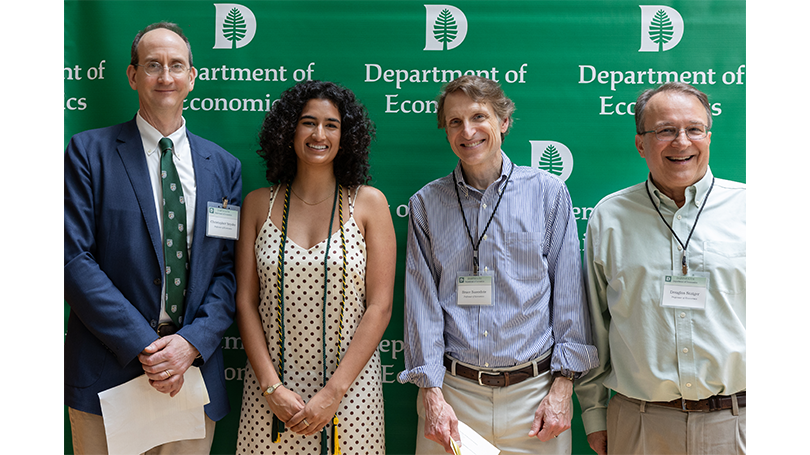
Ranesa Khanna (High Honors and Nelson A. Rockefeller Prize) with Chris Snyder, Bruce Sacerdote, and Doug Staiger
-
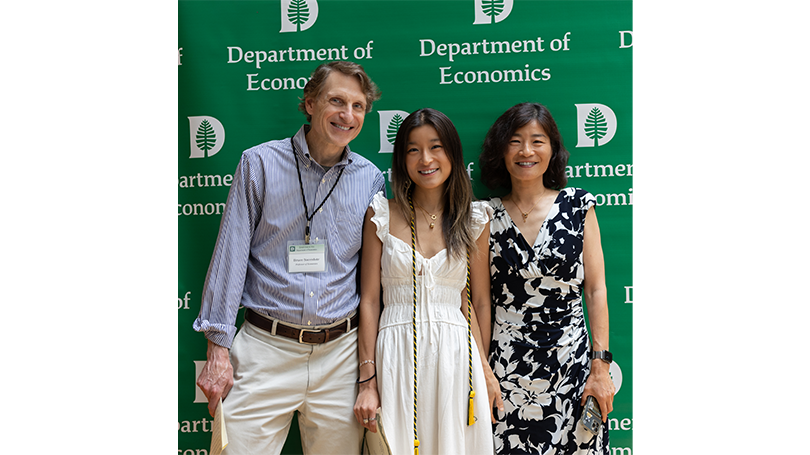
Keren Luo (High Honors and Nelson A. Rockefeller Prize) with Bruce Sacerdote and family
-
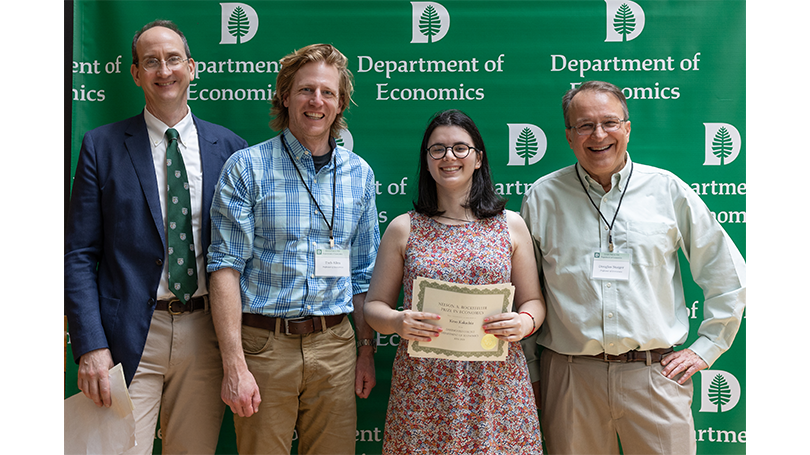
Keso Kakachia (High Honors and Nelson A. Rockefeller Prize) with Chris Snyder, Treb Allen and Doug Staiger
-

Hoang Nguyen (High Honors and Nelson A. Rockefeller Prize) with Chris Snyder